

Make the tradeoffs of change visible.
An investment can increase capability while reducing short-term margin. A cost reduction can improve efficiency while weakening quality, trust or future opportunity. A strategic shift can create growth while increasing strain somewhere else. Every decision changes more than one thing.
The Value Creation Equation creates a shared way to examine those relationships—bringing different forms of value into view so leaders can make more confident decisions.
The Value Creation Equation creates a shared way to examine those relationships—bringing different forms of value into view so leaders can make more confident decisions.
Preface
Read the Equation as a way to understand relationships between choices, not as a formula that produces answers.
Making value comparable
The same decision can create different kinds of value.
Most businesses have sophisticated ways to measure what happens financially.
Revenue. Margin. Cost. Growth.
Those measures matter.
But they do not capture every form of value a decision creates or consumes.
A decision to delay maintenance may protect this quarter's margin while increasing future risk.
An investment in people may appear as a cost while strengthening capability, quality and retention.
A process improvement may not create immediate revenue while reducing friction across the entire organization.
These forms of value are easy enough to understand. The challenge is that they rarely exist in the same conversation.
The Value Creation Equation creates a shared structure for seeing them together.
Revenue. Margin. Cost. Growth.
Those measures matter.
But they do not capture every form of value a decision creates or consumes.
A decision to delay maintenance may protect this quarter's margin while increasing future risk.
An investment in people may appear as a cost while strengthening capability, quality and retention.
A process improvement may not create immediate revenue while reducing friction across the entire organization.
These forms of value are easy enough to understand. The challenge is that they rarely exist in the same conversation.
The Value Creation Equation creates a shared structure for seeing them together.

Metrics to Movement
Every intervention changes the system.
The Equation begins with a proposed change:
An investment.
A reduction.
A new capability.
A strategic shift.
A different way of operating.
That intervention moves through the five dimensions of value:
An investment.
A reduction.
A new capability.
A strategic shift.
A different way of operating.
That intervention moves through the five dimensions of value:
The Equation is bigger than one right answer. It asks "What changes when we choose this?"
Craft
How does this affect what we create and how people experience it?
Craft looks at whether the organization can make and deliver something people genuinely value—and keep doing it well as conditions change. It considers the people and capabilities behind the work, the experience created, and the proficiency required to deliver it reliably.
Considers
People · capabilities · technology · products & services · customer experience · delivery · scalability

Result
How does this affect the business model, resources and outcomes?
Result tests whether an idea creates enough value to justify what it consumes. It considers the economics of the business, the systems and resources that support it, and whether its intended impact can be sustained over time.
Considers
Revenue · margin · assets · capital · operations · supply chain · resilience · measurable impact

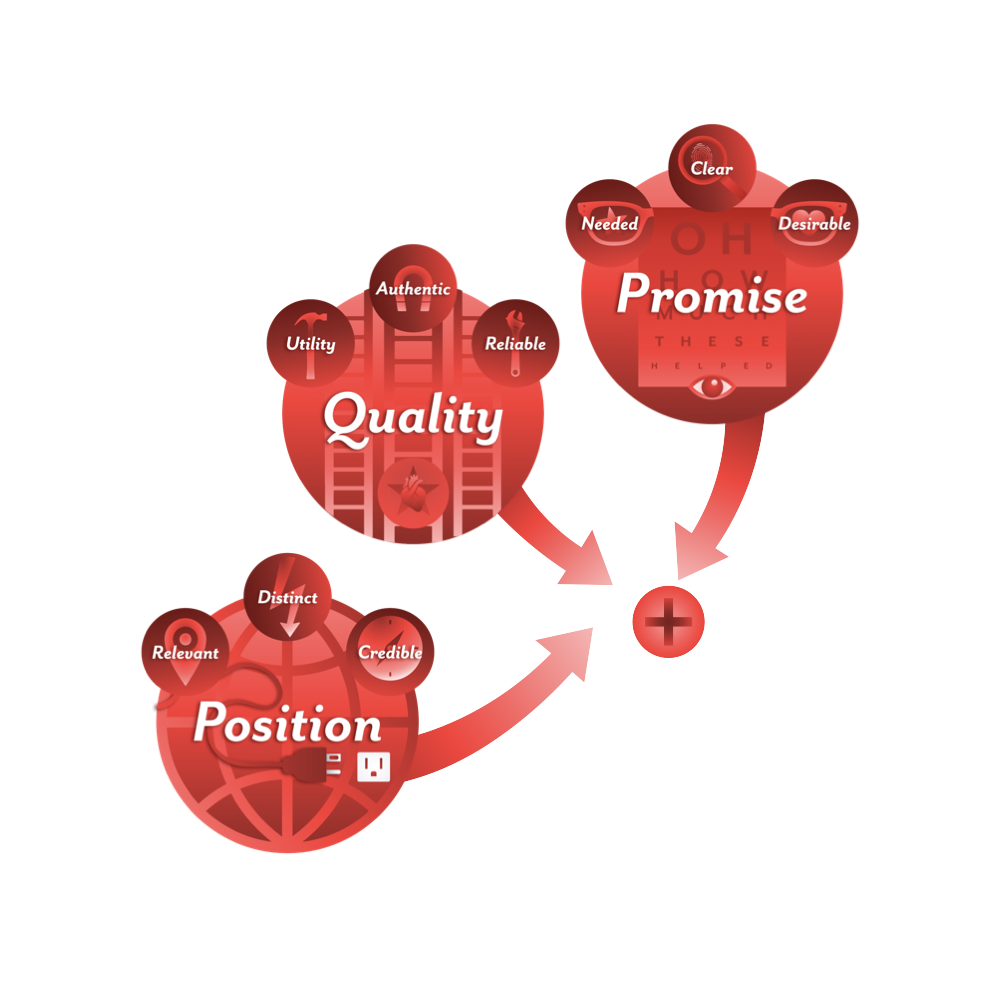
Purpose
How does this affect the promise, position and meaning of the business?
Purpose examines why this belongs in the world and why people should care. It connects what the business promises with the quality of what it delivers and the position it can credibly occupy.
Considers
Customer need · brand promise · differentiation · relevance · credibility · quality · reputation
Horizon
How does this affect future possibilities and opportunities?
Horizon looks beyond the immediate decision to what it could make possible—or foreclose. It considers changing markets, opportunities worth pursuing, paths for growth, and the conditions that determine whether those possibilities are actually accessible.
Considers
Market · demand · competition · trends · opportunity · optionality · growth · defensibility

Traction
How does this affect the organization's ability to carry the change?
Traction examines whether the organization can turn intention into coordinated movement. It considers whether people understand the direction, have agency to act, trust one another enough to move together, and can sustain momentum through change.
Considers
Leadership · alignment · priorities · decisions · trust · agency · coordination · momentum

The shape of a decision
Make the tradeoffs visible.
Every meaningful decision includes exchange.
Something increases.
Something decreases.
Something becomes possible.
Something becomes constrained.
Traditional analysis often isolates the most visible measure.
The Equation expands the view.
A factory upgrade might reduce short-term margin while improving worker conditions, operational reliability and future capacity.
A new product line might create revenue while increasing complexity beyond what the organization can sustain.
A cost reduction might improve efficiency while transferring hidden burden onto people, customers or future capability.
The Equation does not eliminate tradeoffs.
It reveals them.
Something increases.
Something decreases.
Something becomes possible.
Something becomes constrained.
Traditional analysis often isolates the most visible measure.
The Equation expands the view.
A factory upgrade might reduce short-term margin while improving worker conditions, operational reliability and future capacity.
A new product line might create revenue while increasing complexity beyond what the organization can sustain.
A cost reduction might improve efficiency while transferring hidden burden onto people, customers or future capability.
The Equation does not eliminate tradeoffs.
It reveals them.
A different kind of confidence
Better decisions do not require certainty. They require clarity.
The future cannot be reduced to a calculation.
But decisions become stronger when the reasoning behind them is visible.
The Value Creation Equation helps leaders understand:
But decisions become stronger when the reasoning behind them is visible.
The Value Creation Equation helps leaders understand:
What are we investing?
Time.
Money.
Attention.
Energy.
Capability.
Time.
Money.
Attention.
Energy.
Capability.
What are we creating?
Revenue.
Experience.
Trust.
Capacity.
Opportunity.
Revenue.
Experience.
Trust.
Capacity.
Opportunity.
What are we consuming?
Resources.
Flexibility.
Relationships.
Future options.
Resources.
Flexibility.
Relationships.
Future options.
What are we changing?
The conditions under which the business operates.
A decision becomes more confident when the full exchange is understood.
The conditions under which the business operates.
A decision becomes more confident when the full exchange is understood.
Traceable choices
From opinion to understanding.
The Equation creates a traceable connection between an intervention and its consequences.
A choice is not simply recorded as:
"We decided to do this."
It becomes:
"We chose this because we understood what it would strengthen, what it would require, what it would risk, and what other possibilities it would create or close."
That understanding allows decisions to be revisited, adapted and improved as circumstances change.
A choice is not simply recorded as:
"We decided to do this."
It becomes:
"We chose this because we understood what it would strengthen, what it would require, what it would risk, and what other possibilities it would create or close."
That understanding allows decisions to be revisited, adapted and improved as circumstances change.

What the Equation reveals
The hidden shape of change.
The Value Creation Equation reveals:
Invisible value
Contributions that matter but do not appear clearly in traditional measures.
Hidden costs
Burden transferred elsewhere in the system.
Tradeoffs
What improves, what declines and what requires attention.
Leverage points
Changes that create outsized effects across multiple dimensions.
Strategic tension
Where competing priorities require conscious choice rather than accidental compromise.
SEEING THE EQUATION AS A WHOLE
Decisions are part of a larger system.
A business is constantly making choices about where to place its limited resources.
The Value Creation Equation makes those choices visible—not as isolated transactions, but as movements within a living system of value.
The Value Creation Equation makes those choices visible—not as isolated transactions, but as movements within a living system of value.
NEXT FRAMEWORK
04 Direction Dial Roadmap
Reveal the path from decision to direction.
The Value Creation Equation reveals the consequences and tradeoffs within a possible choice.
The next question is how those choices become movement over time.
The Direction Dial Roadmap connects immediate action with longer horizons, creating a path that allows the business to move intentionally toward what it is becoming.
The next question is how those choices become movement over time.
The Direction Dial Roadmap connects immediate action with longer horizons, creating a path that allows the business to move intentionally toward what it is becoming.